The Dilemma of the Blank Page: Bridging Architectural Intuition and Climate Data with Ladybug Tools
Today, it is impossible to bypass sustainability in architectural design. The built environment accounts for over a third of global energy-related carbon emissions. In the UN publication Building Materials and the Climate (2023), a clear distinction is made between embodied and operational carbon emissions. Understanding this difference is crucial if we are to successfully decarbonize our cities.
For an architect navigating the early stages of the design process, this distinction should shape the workflow in two ways: first, it dictates the selection of sustainable materials based on their embodied emissions; second, it demands an understanding of how the building will perform within its local microclimate—what we define as operational sustainability. In other words, true sustainability isn't just about what the building is made of; it’s about how it performs in its given environment.
At the very beginning of a project, an architect’s leverage is at its absolute peak. Every line drawn on a blank page sets a trajectory for the building’s entire lifecycle. Yet, this is also the moment when we have the least amount of hard data. Traditionally, sustainability has been treated as a checklist applied after the building’s form is already locked in. To bridge the gap between architectural intuition and climate reality, we need data-driven tools from day one. This is where Ladybug Tools changes the game.
Ladybug Tools is used for simulations of climate data within the built environment. In essence, simulation means modeling a process to predict how a system will behave, allowing us to anticipate outcomes without building costly physical prototypes or taking unnecessary risks.
Ladybug Tools, which is an open-source plugin for Grasshopper and Rhino, enables a parametric link between the building’s geometry and climate data. The software utilizes industry-standard simulation engines to process local weather files and geographical data. By integrating highly validated engines like Radiance for daylighting and EnergyPlus for thermal energy, it analyzes everything from solar radiation and wind patterns to temperature and thermal comfort. The complex data is then translated into clear, highly visual diagrams. In this way, early-stage design decisions are grounded on a scientific foundation rather than general assumptions.
However, before deploying Ladybug Tools, we must first understand the specific challenges arising within a given microclimate. Is the project located in a Mediterranean climate with hot, dry summers, or a continental climate with warm summers and freezing winters?
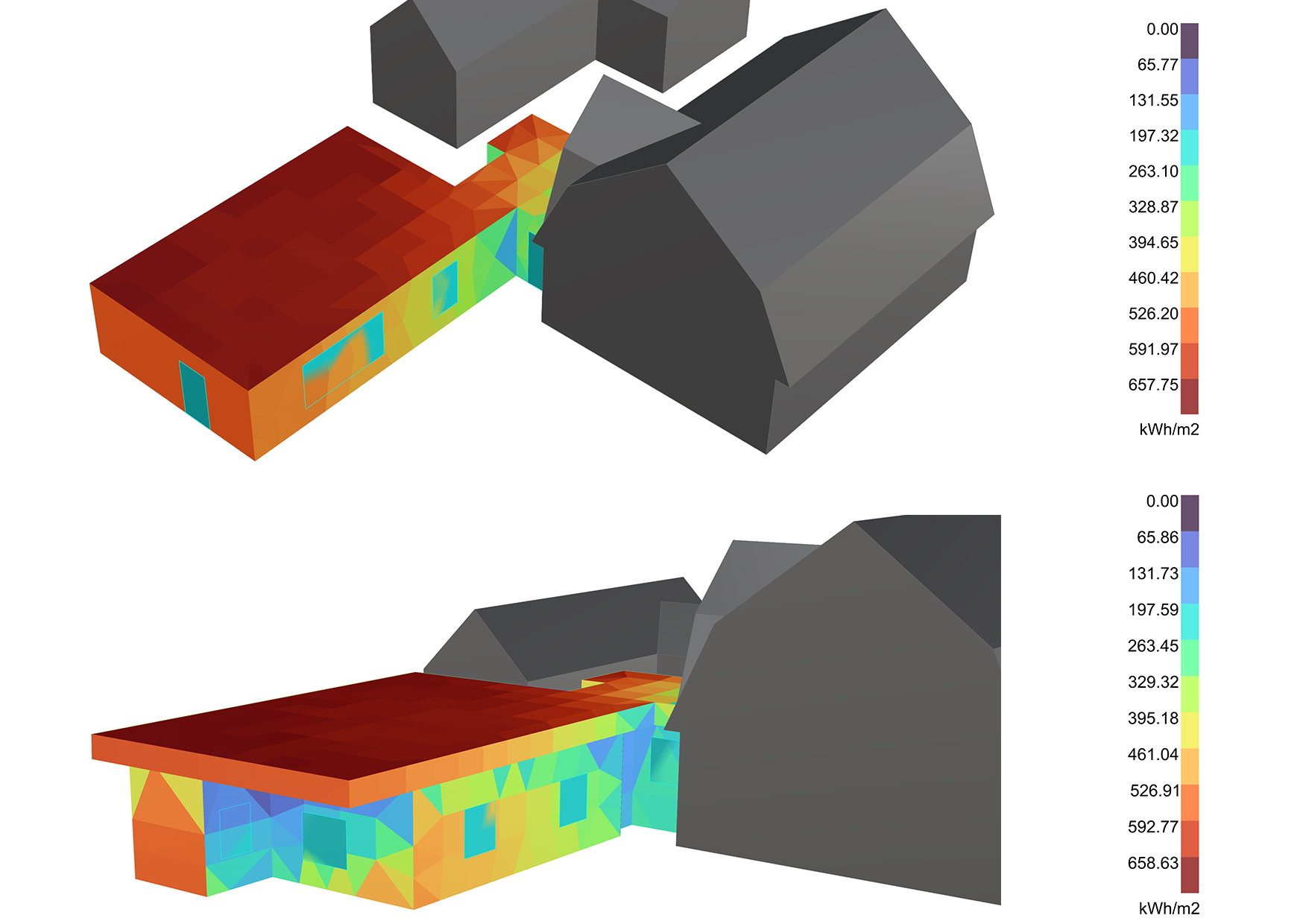
Below is one of several Ladybug analyses for an extension to a single-family house in Sweden—a temperate continental climate characterized by warm summers and cold winters. The visual analysis is divided into two distinct periods to showcase the impact of the geometric optimization on solar radiation kWh/m2):
To build a truly sustainable future, we must address both sides of the carbon equation: the materials we build with and how our buildings perform over time. While tools like Ladybug Tools give us unprecedented insight into microclimates and operational performance, we must remain critical readers of the information. Both input and output data carry inherent uncertainties that require thoughtful context and caution.
Ultimately, data alone cannot design a building. It provides the foundation, but it cannot replace human intuition, critical thinking, and the strategic vision of the architect. By combining data-driven insights with empathetic, human-centered design, we can create spaces that are not only environmentally resilient, but truly inspiring to live in.